Feeds:
Posts
Comments

Her backyard is terraced with fill and stone.  Concrete, wood and stone walls hold back the dirt, imported at cost, that have helped to create the textures that embrace the luscious, shaded landscape of ferns and hostas, day lilies and others indigenous to deep woods flora and fauna.  There are ponds and a waterfall where she reads with summer’s breeze from the river lulling her to sleep.

Water and the whisper of winds commingle as butterflies and hummingbirds land on scarlet flowers. Redolent white roses and peonies perfume the air as do rosemary and mint when brushed.    Birds of all shape and color and nationality nest in the firs and hemlocks and take turns in their cacophony of sound.

Early morning, when she walks the gardens and lifts her hands in praise, the heron swoops along the riverbed, an ancient bird on a mission to unfettered ponds.  He returns in late afternoon, perhaps the original Phoenix, standing on a log in the river, waiting patiently for his prey.

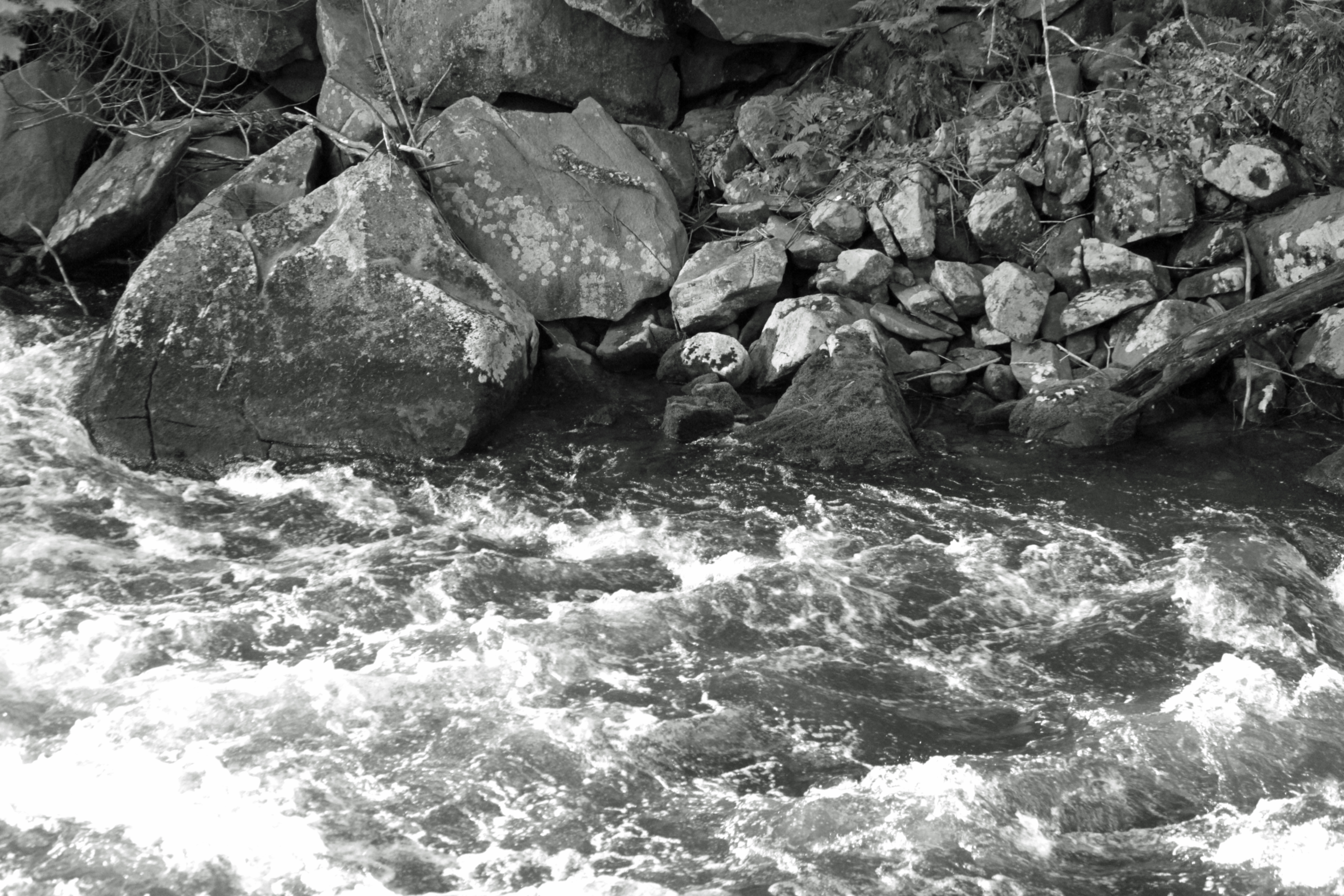
Her riverbed is filled with stones laid smooth by the force of a surging waterfall above.  Its  sound from the rocks simulate Rachmaninoff in her muse.

#17 Untitled

He sat in his car at a rest stop near their apartment and saw the van go pass.  He was sure it was her father’s.  She had been silent that morning as she poured their coffee.  Her thin arms were black and blue where he had grabbed her as she tried to run to the children.  Her face had a welt of red like a hand had slapped it again and again.  She moved as though afraid of her shadow, her hand shaking as she lifted the cup to her lips.


That morning, he hid behind the newspaper and was grateful when his son started to cry and she left the room.  All that he remembered about last night was that she wasn’t asleep when he walked through the door.  He hated her when she did that.  He was tired and didn’t want to talk.  She whined and cried.  He hated her cries; they made him unsettled.  She antagonized him with accusations and then walked away; that made him very angry.  She deserved to be hit.  “Bitch.”


#16 The Swan

Luke and OJ and I have adventures.  Doesn’t everyone with a two and a half-year old grandson and pug have them?  We start out just after Luke’s Mom or Dad leaves, hustling around the house to find my shoes, unearth the car keys, and packing a snack and water.  We often include carrots that all of us like, including the horses,  just in case we visit the stables.

In the hills of Litchfield, we are five minutes from two lakes, a placid river, 4,000 acres of protected forestland with trails and a fantastic museum for naturalists, which we are, all three.  A little further down the road are the stables, two of them, a farm with chickens, pigs, sheep and cattle from Africa.  There are other farms we visit, but none so picturesque as this.  We hike the year round and use walking sticks bleached from the waters of Cape Cod, another favorite place.

One day in May, we took a trail less travelled and found an isolated pond with swans.  Luke said that it was the Mommy and Daddy.  I should have believed him.  Ever the photo journalist, with my Canon 500 around my neck, I secured OJ to a tree, and sat Luke on a rock, near enough to see but away from the marsh land I walked into with my zoom engaged.

Only one swan seemed interested in what we were doing and was swimming towards us.  A second or two of shooting was enough to raise goosebumps when I realized the bird was moving far too fast to be friendly.  Perhaps we disrupted a mating or there was a young one to protect, I thought as I turned tail.  The swan was just beyond the bull rushes with the next stop being shore.

I swooped up Luke and untethered OJ who had not barked at all.  Running down the gravel path to the safety of our car, Luke was weightless in my arms and OJ led the way, sensing my alarm.  As I secured Luke into his car seat, he asked why the swan didn’t have any eyes.    I couldn’t answer.  We went home so that I could look up his question and download the pictures.  We learned that the swan’s eyes are the same color as their beaks, and are barely discerned in the black hood, a protective measure.  The swan could have attacked us that day, but the stars were in alignment to protect us; a typical day with Mimi.

Mine is not the southern version, but the northern.

Preheat your oven to 400 degrees.  Have a “dry” cookie sheet immediately available.

Our biscuits are made with flour, milk and butter and a teaspoon full of baking powder.  Cut the butter into the flour, add a touch of salt and baking powder and make a little pond area in the center for the milk; add it all at once and gently stir until the flour mixture is wet.  Plop a large tablespoon or so of the biscuit mix onto your cookie sheet and bake for 10 to 12 minutes until golden brown.   Hope that all biscuits will rise to the occasion.

While your biscuits are in the oven, wash and core beautiful, fresh, red strawberries.  Reserve at least four of the berries, quartering them for the tops.  Slice the remaining and then mash them with a potato smasher, add sugar on top, not too much and not too little; run some warm water over them and gently fold them over to create a  juice to go with the berries.  If you have a ripe, but not too ripe banana, slice that up and put it into the strawberries.  The banana adds potassium to the Vitamin C of the berries, making the desert divinely nutritious.  Your biscuits should be ready to take from the oven.

Let your biscuits stand for just about three minutes and slice in the middle.  Take a pat of butter, preferably at room temperature and smother the bottom, returning the top of each biscuit.  Get out your whisk and stainless steel bowl and remove your carton of “heavy” cream from the refrigerator.  Don’t be fooled by the labels; “whipping cream” is not the same.  For your berries, you must use the heavy cream.  Whisk it like hell, get it into good shape and then add some sugar, powdered if you are not using it right away, or granulated.  Then add the pure vanilla, just a capful; it is so expensive.

Time to assemble:  Wash your blueberries.  Remove the top half of your biscuit, and fill it with the berry and banana mixture;  add a dollop of whipped cream.  Add to this your top half of the biscuit and give it a second dollop of whipped cream.  Sprinkle the blueberries generously on top, and in the center, stand a quarter of a strawberry.  Add a small American flag if desired.  Bon Appetit.

#14 Is it You?

I saw you the other day, or at least I think it was you.  “How would a mother not know her own son?” I thought.  I saw you from the side, and it looked like your profile.  There was a long line of kids separating us, kids waiting to dip their candles into wax again; round and round they went to the station with the melting wax.  Was that my granddaughter with you?  I saw a little blonde girl with a heavy-set woman.  She was standing next to you.  Was that her aunt, your wife’s sister?  I haven’t seen you for six years even though we live in the same town, and don’t know if you would know me.  Have you seen me?

I can remember the day exactly when you stopped talking to me.  You had called to share the news of the pregnancy.  I wasn’t home, and for four days, I called the wrong number, one digit off, and told a machine how happy I was.  I said, “Let’s celebrate with dinner.”  Each day, I called, a little more urgent.  “Hi, why haven’t you returned the call?”  and “Hey, what’s up?  Pop and I want to take you to dinner.”  On the third day, I just said, “I hate this machine, if you’re there, please pick up.”  Waiting a moment, I hung up.  On the fourth day, there was a strange voice on the other end; no machine that sounded just like yours.  The voice said, “I’m sorry but you have been calling a wrong number.  I have your messages, but didn’t have a return number to let you know.”  My heart fell to the pit of my stomach.  I was four days too late to celebrate with you; to rejoice that finally there would be a baby.  I called the right number:  too late, you didn’t answer.  You didn’t return the call even though I apologized.  I called and called, and finally even went to your house, but you weren’t home.  I left a note, but it was too late.  You knew I was sorry, but you didn’t care.

I had been sick that day I didn’t know if it was you.  It was the first time in six years that I thought it was you.  Perhaps you didn’t know me, and that’s why you walked away when I waved across the line of kids waiting to dip their candles.  Or perhaps it was just too late.

Inspired by Susan Gibb “Eye Contact.”

#13 Cubby Hole

Our house was built on a concrete foundation, all that was left when the fire took the two-story house where one of the men died in the flames.  My mother always hated the house, even though it was the largest in that country neighborhood, and even though it had two acres where we could run and play.

Mom had a needle on a string that she held over each of us when we married, a ritual that some of us would not agree to.  As I remember, if the needle went in a circle, there would be a girl; if the needle went back and forth, it would be a boy.  Twins would be designated by the needle stopping on its own accord and then starting to move again, almost immediately.  We watched her with hawkish eyes to see if she manipulated the needle.  The needle stopped on its own each accord after going round or sideways, determining sex, and she would then begin again to determine the number of children.  Through the years, we found her needle predictions to be correct for each of us.   We often questioned if it was the needle or Mom who had the power.

There were strange things that went on in our house, particularly in the cubby holes that were in the two second-floor bedrooms.  The storage areas were created under the roof; it was dead space that ran the length of the room, one on either side in each bedroom.   Our vivid imaginations told us that the cubby holes were alive; they held the spirit of the man who died, and some nights we would swear we heard his voice, the wind whispering through the eaves, coming through its louvers.  My Mom was very sick one time, and she decided to use our room to sleep instead of her room downstairs.  Three of us slept in the other room for two nights.  I don’t remember what she was sick with, but the second night we heard her scream.  We went running across the hall, and she was standing at the foot of the bed, her finger-pointing to the open cubby.  Its light was on.

Mom had seen her mother, my grandmother, that night; she had seen her bright brown eyes and brilliant white hair.  She insisted that it was not a dream, that her mother was in the room stooped over and then straightening out of the cubby.  Early that morning, we had a call that Grandma had died.

Years later, the idea came to my sister that she could make a rocking chair in the other room rock by using her mind.  When we talked about it, I mentioned that my mother’s lamp in the guest room lit itself whenever I had deep thoughts about her.  We wondered if we should tell the others; if perhaps they, too, had some type of power.  We thought better of it, and decided not to.  We never talk about whether or not she rocks the chair anymore, and I still have Mom’s lamp that lights every now and then.

Inspired by Jonathan Blais “Cooby Hole.”

#12 The Raft

Claudia and I had worked together for years; she as the office manager, and I as the only woman salesperson.  Our relationship changed when she came to work with me at the agency.  As contemporaries, we  became the best of friends.

Our children were about the same age; she had three boys, and I had too many to talk about.  So, we primarily talked about her boys and their antics, and I gave her my unprofessional therapeutic advice.  We generally had our best talks over the incredibly mouth-watering brownies she made with a topping from sweetened condensed milk, toasted coconut and chocolate chips.  My waistline has never been the same.

That summer of our golden years I had picked up a huge rubber raft with oars at the Army and Navy store,  and Claudia and I decided to take it out on Bantam Lake.  We blew it up at my house, hoisted it onto the car and ran it down to the lake early, just after my kids were on the bus.  Her husband took care of hers for life, but at that time I was in sole charge of mine.  Each of us wore crummy t-shirts, shorts and sneakers.  Our cooler was filled with the luscious brownies, sandwiches and iced tea; a little fruit and Claudia’s cigarettes.

The day was splendid, just as planned; a typical Connecticut morning with bright blue skies and barely a cloud.  When we launched our craft, there was hardly a ripple in the placid waters.  It was a Monday in June and weekenders had left; the lake had few boats on it.  We took turns paddling until we lost one of the sticks.  It was floating just beyond the raft, and I thought I could reach it with the other.  Unfortunately, when I stood up, the raft leaned sideways, and I fell overboard.  “How hard is it to get back into a raft,” I thought.  Claudia had the presence to remain seated in the stern during my fiasco, and the boat, thankfully, did not flip over.

That day I found out how hard it is to lift a leg with waterlogged sneakers out of the water onto a raft.  For an aged woman, it was impossible.  The stars, though, were in position to favor me, and as I hanged on, I was able to inch the shoes off.  Contrary to public opinion, sneakers float only for a certain time, and plastic oars float away at an amazing speed.   I saw them go just as I hoisted myself up and over the side of the raft.

Although we didn’t see any boats we could flag down, the day, we thought, was not an entire loss; our picnic was still intact.  After the physical and emotional exertions, we were starving.    Polishing off the contents of our carry-on, we gave little thought as to how long we might be stranded in the middle of a five-mile long lake.  I decided to remove my shirt thinking I could use it as a mast or makeshift kite, or something to wave at a passing boat, but there wasn’t any wind and no one was on the lake at that time of day.   Lulled by the aimless drift of the water and the warmth of the sun, we hunkered down for a short nap.

I awoke first and nudged Claudia with my bare foot.  By the looks of the sky, we had passed high noon and were reaching beyond mid afternoon.  We had to get serious.  Our drifting had taken us further into the bay, and there were few houses in this protected area, most of them unoccupied until July.  We decided to use our hands as paddles.  At first we were just spinning around, and once our hands were in synch, we started to move inland.  It seemed we were moving at a snail’s pace when we sprang a leak and then time lay suspended.  Using paper cups, we bailed with one hand and paddled with the other.  By the time the state police found us, our little raft had only one section still filled with air, and we were glued to it, paddling with our feet.  Strong arms lifted us into their boat; one of the policemen covered my shirtless, sun-burned back with a blanket.

Claudia had sun poisoning and was out of work for a week; in bed for three days.  A side benefit was that she kicked the habit and gave up smoking.   I recovered quickly, but did, for the first two days, shine as though radioactive.  That same summer we bought individual kayaks and took some lessons.  To this day, we use the lake only for swimming and do our best boating on the Bantam River.  Though we have aged, the brownies have not changed.
1.  The flagpole at Southeast School was my nemesis on dark summer nights when I crossed the river and ran through an open field  past the school, collapsing in Grandma Torsiello’s yard, minutes from my own.  I lay on top of freshly mowed grass and covered my ears while catching my breath.  The wind, my friend in any other circumstance, caught the metal at the bottom of the pole and slammed it hard, metal against metal, rhythmic, haunting; voices of the past.  It was the year I fell in love with mysteries, a year before I discovered boys.

2.  Dad was in the kitchen getting his tools for our turkey dinner.  Mom was in the hospital, and I had cooked dinner.  The boys, having found my cooling rolls when my back was turned, were outside, hitting with the bat, those perfect, misshapen mounds of dough resilient even to oak.  Dad had a serving fork and carving knife in either hand, running one over the other, metal against metal.

3.  I was 13 and Tommie was 15. To my brother Larry, I was his Nemesis, and I did everything to provoke his ire.  That day, his Nash Rambler was parked in the driveway; washing it before he caught the game at the nearby field.  Watching  him hang the keys under the porch on a rusted nail, I had an idea to start the car and move it closer to the garage.  Tommie thought it was a bad one and stood  outside the car while I turned the key.  I took my foot off the clutch, the way I had seen Dad do it, and the Rambler lurched forward, its wheels turning without my trying.  Front wheels went over the bank, and the front fender hit our burn barrel, metal against metal when the car stalled.  The ball team came running to see what had happened, and before I could think, Tommy pulled me out of the car and sat in himself.   Larry suspected that it was me, but it was Tommy who took the rap.


#9 New York

John, my oldest brother, was the only one of nine children born in New York City at Jamaica Plains Hospital in the mid 1930’s.  Mom,  younger, by 10 years than Dad, had fallen madly in love with the handsome, slim Northern Italian with a black, brim-turned-down fedora.  Her father, an itinerant farmer, who moved his family from home to home, didn’t like Italians and said my Mom should never call or see them again. When  John came home from the hospital, he slept in an open bureau drawer lined with soft blankets; there was no money for a crib.

During that Depression time, there were few jobs in the country, but Dad had connections in New York, and he drove new cars to Miami and Las Vegas, coming back on the train.  Often, Dad would be longer than expected and Mom learned to ration the peanut butter and bread so Dad would have something to eat when he returned.   One day he came back with a high fever; his body trembling with shivers.  Mom said he was delirious and feared it was pneumonia.  The snow that early spring morning had  turned to slush when Mom wrapped John in all of his blankets and took the money she was saving for boots out of the glass jar with the brass top.  She kissed her handsome man’s fevered brow and said she would be back with medicine.

On foot, buffeted by a March wind, she navigated  the wet sidewalks and flooded streets, and held John tight to her thin coat as they stood at a corner waiting for the light.  She could see the sign for the pharmacy on the next block.

A Packard, the kind Dad drove to his clients, took the corner too fast, and Mom and John were drenched.  With a screech of brakes, the car stopped just beyond, and a well-dressed matronly woman came to their aid.  Apologizing and taking Mom’s arm, she led them to the polished black car, and her man helped them in.

The penthouse apartment on Park Avenue was filled with thick oriental rugs, precious porcelain imports and a blazing fire in the livingroom where she was led.  The woman offered to take John while Mom dried off with thick cotton towels.  She ordered tea and breakfast and noticed the young mother’s wet shoes.  Restoring John to Mom, she went into another room and came back with a thick wool coat and high black boots that buttoned to the side.  “We’re just about the same size,” she said, “try these on.  I just bought some new ones.”  Mom was reluctant; proud, didn’t take handouts, but she was also practical and knew about answered prayer.  She tried; they fit.

The woman had her chauffeur drive Mom to the drugstore, where she found medicine.  She also found a $50 bill in the pocket of her new coat.  When she and John returned to the little apartment, and he was tucked into his bureau drawer, fast asleep, she woke her young husband, gave him a dollop of the medicine, and took off her coat and new boots to lie beside him.